
Why Rooftop Exhaust Fan Maintenance Can’t Wait: Fire Risk, Roof Damage, and Insurance Liability

The rooftop exhaust fan is the unsung workhorse of any commercial kitchen ventilation system. Line cooks and kitchen managers tend to focus on the gleaming stainless steel hoods above the ranges, but the real structural risk builds up unseen, stories above on the roof deck. Operating a commercial kitchen in Atlantic Canada — whether it’s a busy seafood restaurant in Halifax, a high-volume diner in Moncton, or a seasonal resort in Charlottetown — means understanding National Fire Protection Association (NFPA) 96 standards inside and out. When rooftop exhaust fan cleaning is skipped, the fallout goes far beyond a failed health inspection: it sets off a chain reaction of structural decay, fire hazards, rising utility bills, and potentially voided commercial property insurance.
This guide walks through exactly how rooftop exhaust fans fail, the chemical damage neglected grease causes to commercial roofing, the legal and financial exposure of non-compliance, and how Night Vision Clean protects commercial kitchens across Nova Scotia, New Brunswick, and Prince Edward Island.

How Grease Builds Up in Your Rooftop Exhaust Fan Maintenance
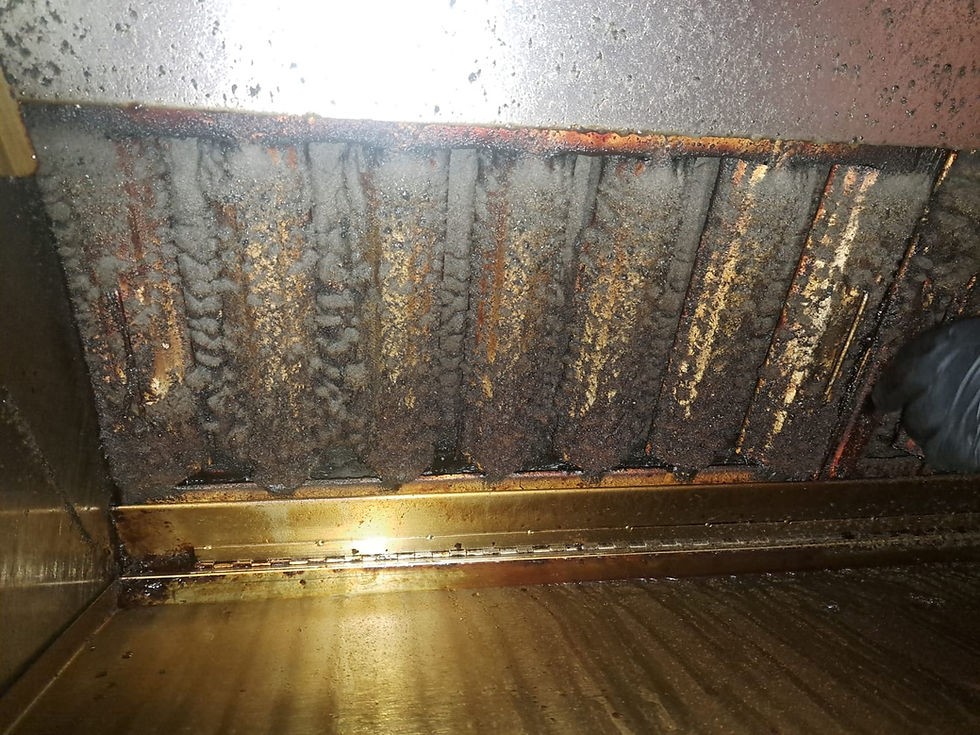
Every time a steak hits the searing pan, fries drop into the fryer, or a burger sizzles on the grill, the kitchen air fills with aerosolized animal fats, vegetable oils, and carbonized particles. The hood system is designed to capture these contaminants before they settle on prep surfaces or impact staff health—but hood filters are only the first line of defense. Even high‑efficiency baffle filters trap only part of the grease. The remainder stays suspended in the hot air stream and is carried upward, where Rooftop Exhaust Fan Maintenance becomes critical. Without consistent upkeep, this buildup turns into a serious fire hazard, compromises air quality, and accelerates wear on the fan and ductwork.
As that grease‑laden air travels up through the vertical ductwork, it cools. By the time it reaches the roof deck, the temperature drop causes the grease vapor to condense back into a liquid, coating the fan housing, blades, motor assembly, and fan bowl. Under a proper Rooftop Exhaust Fan Maintenance schedule, a certified cleaning company extracts this grease with high‑temperature, high‑pressure steam on a set cadence. When that schedule is ignored, delayed, or handled by uncertified budget cleaners who cut corners, the grease keeps layering up month after month—and that’s where the damage to your building really begins.
Mechanical Failures and Operational Downtime
A commercial upblast exhaust fan is built from a heavy-duty electric motor, a belt-drive system, a fan wheel or impeller, a protective housing, and a grease spout that directs accumulated grease into a containment system. The motor spins the impeller at high speed, creating the negative pressure that pulls smoke and vapor out of the kitchen.
Grease doesn’t build up evenly on the fan wheel. It’s sticky, so it catches dust and debris as it accumulates, gradually throwing the wheel out of balance — the same way a car wheel vibrates violently when it’s carrying a heavy, off-centre weight. An unbalanced, grease-logged fan wheel sends intense vibration through the housing and down into the roof curb, loosening bolts, degrading weather seals, and cracking the sheet metal housing over time. That vibration can even travel down the ductwork as a low-frequency hum felt in the dining room below.
The consequences of an unbalanced wheel compound from there:
• The motor has to pull significantly more current to spin the imbalanced wheel, leading to overheating and premature bearing wear.
• Sustained overexertion eventually causes complete motor burnout — often during peak service.
• Without the exhaust fan running, the kitchen rapidly fills with smoke and heat, forcing a halt to cooking and a dining room evacuation.
• Grease-coated drive belts slip, squeal, and eventually snap, causing the same kind of shutdown.
A burned-out fan motor on a busy Friday night is a costly event on its own — lost service revenue plus emergency after-hours technician rates routinely exceeds what a year of scheduled professional cleaning would have cost.
Chemical Degradation of Commercial Roofing Systems
Mechanical failure is an operational risk; what happens to the roof is a financial one. When the fan bowl fills with liquid grease, it eventually overflows. Standard upblast fans rely on a small drain spout, and that grease needs to be caught by a proper containment system — something many commercial kitchens in Atlantic Canada either lack entirely or have undersized for their cooking volume. When it overflows, the grease pours directly onto the roofing membrane.
Commercial roofing membranes share one critical vulnerability regardless of material: they react badly to animal fats and vegetable oils, which are acidic. Pooled grease breaks down the membrane’s molecular structure over time.
• EPDM rubber roofs blister, swell, and turn soft and jelly-like.
• TPO and PVC seams dissolve and separate.
• Built-up asphalt roofing simply disintegrates.
Once the membrane fails, Atlantic Canada’s harsh, unpredictable weather does the rest. Rain, freezing sleet, and melting snow bypass the compromised membrane and soak into the insulation underneath, which loses its thermal resistance — driving heating and cooling costs up. Eventually the water and grease mixture reaches the structural deck: wood decking rots and harbours toxic black mold, while steel decking rusts and deteriorates.

Because this damage happens out of sight, restaurant owners are often unaware until a leak suddenly appears in the kitchen ceiling or dining room floor — by which point the structural rot has already spread extensively. Replacing a grease-destroyed commercial roof can run into the tens or hundreds of thousands of dollars. Night Vision Clean mitigates this risk by thoroughly degreasing the rooftop fan assembly and installing weather-resistant grease containment boxes fitted with hydrophobic filter pads, which capture grease while still letting rainwater pass through cleanly.
NFPA 96 Compliance and Insurance Liability
Commercial kitchens carry an inherently high fire risk, which is why property insurers require strict adherence to fire safety codes — primarily NFPA 96, the definitive standard for ventilation control and fire protection in commercial cooking operations. It sets the required cleaning frequency, approved cleaning methods, and the documentation needed to prove compliance.
Most commercial insurance policies include a protective safeguards clause: coverage is contingent on the owner keeping all fire protection systems, including the exhaust ductwork and rooftop fan, in proper working order and in compliance with fire code. After a kitchen fire, the insurer’s forensic investigator isn’t only determining the cause — they’re assessing whether the owner held up that end of the contract.
If the investigation finds the rooftop fan heavily choked with grease, or the ductwork not cleaned to bare metal by a certified professional, the insurer has grounds to classify the fire as owner negligence and deny the claim outright. At that point the owner is on the hook for rebuilding, replacing equipment, compensating affected neighbouring businesses, and any resulting lawsuits — often enough to bankrupt a hospitality business outright.
This is the core reason routine professional cleaning is a liability shield, not just a maintenance line item. Night Vision Clean understands exactly what insurance underwriters and fire marshals across Atlantic Canada look for. After every service, clients receive a full digital report with time-stamped, high-resolution photos of the cleaned fan blades, the emptied grease trap, and the bare-metal ductwork interior, along with official NFPA 96 compliance tags affixed to the hood — so if a health inspector, fire marshal, or insurance agent ever asks, the proof is already on hand.
How Night Vision Clean Protects Your Kitchen and Building
Night Vision Clean Maintenance Ltd. is the trusted partner for commercial kitchen exhaust optimization for restaurant owners, facility managers, and hospitality groups across Halifax, Moncton, Charlottetown, and the rest of Atlantic Canada. We don’t do surface-level scraping or visual-only cleaning.
• High-temperature chemical extraction that strips grease down to bare metal, from hood filters to the rooftop fan housing.
• Full NFPA 96-compliant service, every time — no shortcuts.
• Heavy-duty fan hinge installation for safer, easier access during service.
• Weather-resistant grease containment systems built for Atlantic Canada’s climate.
• Time-stamped digital compliance reporting after every visit.
Do not wait for a roof leak or a surprise fire inspection to find out where your exhaust system stands. Contact Night Vision Clean today to schedule a comprehensive facility audit and protect the long-term safety of your commercial kitchen.

Frequently Asked Questions
How often should a rooftop exhaust fan be cleaned?
NFPA 96 sets cleaning frequency based on cooking volume — ranging from monthly for high-volume operations like 24-hour kitchens, to quarterly or semi-annually for lower-volume kitchens. A certified inspection can confirm the right schedule for your specific operation.
Can a dirty exhaust fan really void my insurance?
Yes. Most commercial property policies include a protective safeguards clause tying coverage to documented fire-code compliance. If a fire investigation finds the exhaust system wasn’t maintained to NFPA 96 standards, insurers have grounds to deny the claim as owner negligence.
How do I know if grease has already damaged my roof?
Common warning signs include soft, spongy, or blistered patches near the exhaust unit, discolouration or staining on the membrane, and interior ceiling stains or leaks below the rooftop fan. By the time a leak is visible inside, the damage has often been developing for months.
What areas does Night Vision Clean service?
We provide commercial kitchen exhaust and rooftop fan cleaning across Nova Scotia, New Brunswick, and Prince Edward Island, including Halifax, Moncton, and Charlottetown.
Ready to protect your kitchen, your roof, and your insurance coverage? Contact Night Vision Clean to schedule a facility audit.


Comments