
Kitchen Exhaust Hood Cleaning in Halifax: How Often, Why It Matters, and What NFPA 96 Actually Requires

Why Kitchen Exhaust Hood Cleaning in Halifax Is a Legal Requirement, Not Just Good Housekeeping
Ask most restaurant owners what their biggest kitchen safety concern is, and they will say fire. Ask their insurance company the same question, and you will get the same answer. Yet, walk into the average commercial kitchen in Halifax, and you will find an exhaust hood caked with grease that has not been professionally cleaned in over a year. This is not negligence — it is a knowledge gap. And it is exactly the gap this guide is designed to close.

Kitchen exhaust hood cleaning in Halifax is governed by NFPA 96, the National Fire Protection Association's Standard for Ventilation Control and Fire Protection of Commercial Cooking Operations. In Nova Scotia, this is not a suggestion. It is the benchmark that fire inspectors, insurance adjusters, and health inspectors use when they walk through your kitchen. Failure to comply can result in your operation being shut down, your insurance claim being denied after a fire, and — in the most serious cases — criminal liability.
Night Vision Clean has been providing NFP96-certified kitchen exhaust cleaning services across Halifax, Dartmouth, Bedford, and all of Nova Scotia for years. In that time, we have seen firsthand the difference between a compliant kitchen and one that is one busy Saturday service away from a grease fire. This guide draws on that real-world experience to give Halifax restaurant owners, kitchen managers, and facility teams everything they need to stay safe, stay legal, and sleep at night.
What Is NFPA 96 and Why Does It Apply to Your Halifax Restaurant?
NFPA 96 is a comprehensive standard published by the National Fire Protection Association in the United States and adopted as the definitive reference for commercial kitchen fire safety across Canada, including in Nova Scotia. It covers the design, installation, operation, and maintenance of commercial cooking ventilation systems — from the hood above your fryer to the exhaust fan on your roof.
The reason NFPA 96 matters specifically to kitchen exhaust hood cleaning is Section 11 of the standard, which outlines mandatory inspection and cleaning intervals based on the type of cooking being performed. These are not arbitrary numbers. They are based on decades of data correlating grease accumulation rates with fire risk.
Under NFPA 96, the cleaning frequency for your hood, exhaust ducts, and fans is determined by how much grease-laden vapour your cooking operation produces:
• High-volume cooking operations — including those using solid fuel like wood or charcoal, or 24-hour operations such as fast-food chains, hospital kitchens, and hotel restaurants — must have their exhaust systems cleaned monthly.
• Moderate-volume cooking operations — which covers the majority of full-service restaurants, pubs, and cafeterias in Halifax — require quarterly cleaning, meaning every three months.
• Low-volume cooking operations — such as day camps, seasonal businesses, churches, and light-use commercial kitchens — require semi-annual or annual cleaning depending on usage.
A certified NFPA 96 inspection after every clean provides the documentation your insurance company needs, and your fire inspector expects to see. Without it, you are not just risking a fine — you are potentially voiding your commercial property and liability insurance in the event of a kitchen fire.
What Happens During a Professional Kitchen Exhaust Cleaning in Halifax?
When Night Vision Clean arrives at your Halifax restaurant for a certified hood exhaust cleaning, we are not just wiping down visible surfaces. A compliant NFPA 96 clean is a top-to-bottom degreasing of the entire exhaust system — the parts you can see and the parts you definitely cannot.
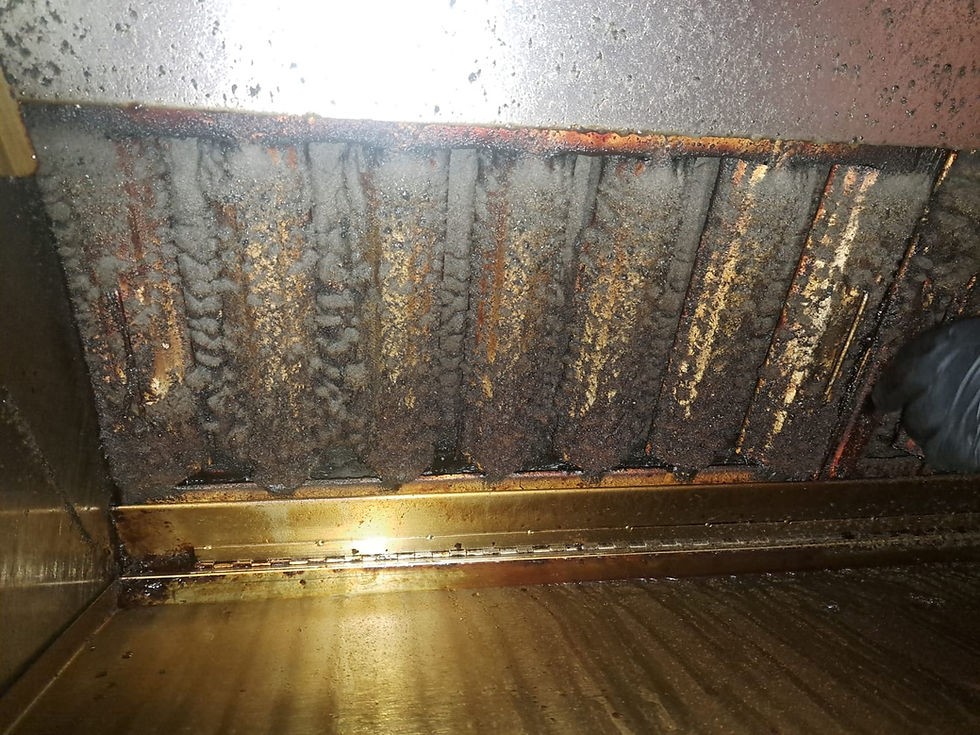
The process begins before we even touch a surface. Our certified technicians photograph the system in its current state, documenting grease levels throughout the duct runs. This before-and-after photo documentation is part of the NFPA 96 certificate we leave with you at the end of every job.
The actual cleaning process covers the following components, every time, without exception.
Hood filters and baffles are removed and soaked in a commercial-grade degreasing solution. Baffles are one of the most grease-saturated components in any exhaust system and require a prolonged dwell time with a hot-water rinse to restore them to a fully clean, fire-safe state.
The hood plenum — the chamber above the filters where grease accumulates before entering the duct — receives a thorough hand scraping of built-up grease deposits before a chemical degreaser is applied and agitated. In high-volume operations, the grease in the plenum can accumulate to several centimetres of solid buildup.
The exhaust ductwork — from the plenum all the way to the rooftop exhaust fan — is cleaned from the inside using specialised rotary brushes and pressurised chemical application where necessary. This is the component that most "cleaning" companies skip entirely, because it requires access panels and specialised equipment. Grease inside ductwork is the fuel source for what fire safety professionals call a duct fire — a type of commercial kitchen fire that travels invisibly through your building's structure before anyone knows it has started.
The rooftop exhaust fan is cleaned, degreased, and inspected for mechanical condition. Fan bearings, belts, and the fan housing all accumulate grease, and all contribute to fire risk if not properly maintained.
After every service, Night Vision Clean applies an NFPA 96-compliant sticker to the system noting the date of service, the company name, the areas cleaned, and any areas that could not be cleaned due to access limitations — because transparency is part of compliance.
How Grease Buildup Leads to Commercial Kitchen Fires in Nova Scotia
Grease is flammable. That is a statement most restaurant owners intellectually understand but viscerally underestimate — because grease does not look dangerous when it is cold and congealed on a hood surface. But heat it to its ignition temperature, which cooking operations do repeatedly throughout every service, and grease becomes a fire accelerant.
The National Fire Protection Association estimates that commercial cooking equipment is involved in nearly 25 per cent of all restaurant fires reported in North America annually. The leading factor contributing to ignition is the failure to clean cooking equipment, including exhaust hoods and ducts.
What makes kitchen exhaust fires particularly dangerous is how they behave once ignited inside a duct system. Unlike a stovetop fire that a kitchen fire suppression system can knock down in seconds, a duct fire travels upward through your building's infrastructure, feeding on the grease coating the inside of duct runs, until it reaches the rooftop fan or finds an opening into the building's ceiling or wall cavities. By the time the fire becomes visible, it has often been burning for several minutes inside the structure.
For Halifax restaurant owners, the local risk is compounded by the age of much of the city's commercial building stock. Many restaurants in the downtown Halifax core operate in heritage buildings where ductwork was not designed to modern fire safety standards and where the distance between a kitchen fire and a structural catastrophe is shorter than in a modern purpose-built commercial space.
Regular, certified kitchen exhaust hood cleaning is the single most effective fire prevention measure available to a commercial kitchen. It removes the fuel source before it can ignite. There is no more direct relationship between maintenance and safety anywhere in a commercial kitchen.
Signs Your Kitchen Exhaust Hood Needs Cleaning Right Now
Beyond the NFPA 96 schedule, there are physical signs in your kitchen that indicate your exhaust system needs attention before the next scheduled clean. Any of the following should prompt an immediate call to a certified hood cleaning company in Halifax.
Visible grease dripping from the hood or filters during service is the most obvious sign of dangerous grease accumulation. If liquid grease is falling onto your cooking line, the buildup above it is substantial and represents an immediate fire hazard.
A persistent burnt or rancid smell in the kitchen even when nothing is cooking suggests grease deposits inside the duct are being heated by the system's natural airflow. This is the smell of grease approaching its combustion point.
Reduced airflow and poor ventilation above your cooking line — your team is noticing more smoke and heat staying in the kitchen during service rather than being drawn up through the hood — indicates that grease buildup is partially blocking the exhaust path.
A kitchen suppression system activation during normal service (not from actual burning food) can indicate heat buildup caused by grease obstructing normal airflow, triggering the heat sensors prematurely.
Grease pooling on kitchen surfaces further from the cooking line than normal suggests the hood is operating inefficiently, spilling grease-laden vapour into the wider kitchen environment rather than capturing it.
If you observe any of these signs at your Halifax restaurant or commercial kitchen, contact Night Vision Clean immediately. We offer same-week emergency hood cleaning for businesses across Halifax, Dartmouth, and the surrounding area.
What Makes Night Vision Clean the Right Choice for Kitchen Exhaust Cleaning in Halifax and Nova Scotia?
There is no shortage of companies offering hood cleaning services in Halifax. What separates Night Vision Clean from a van with a pressure washer is certification, documentation, and accountability.
Every Night Vision Clean technician who works on a hood exhaust system is trained to NFPA 96 standards. We do not cut corners because cutting corners in this trade has physical consequences — for your kitchen, for your staff, and for your insurance coverage. We follow the standard because the standard exists to keep people alive.
We work after hours because your kitchen does not stop producing revenue during the day, and we respect that. Our cleaning teams work through the night so that your kitchen is clean, compliant, and operational by the time your morning prep team arrives.
We operate 24 hours a day, seven days a week across Nova Scotia, New Brunswick, and Prince Edward Island. Whether you are a single-location independent restaurant in downtown Halifax or a multi-unit hospitality group with properties across Atlantic Canada, we can schedule and execute your exhaust cleaning program without disrupting your operations.
Every service includes a full before-and-after photo record, an NNFP96-compliantservice sticker, and a written service report — all of which can be submitted directly to your insurance provider and fire inspector as evidence of compliance.
Our grease trap and interceptor cleaning service means we can maintain your entire kitchen's grease management system — hood, duct, rooftop fan, and grease trap — under a single service agreement. This matters for Halifax restaurants because your municipal connection to the Halifax Regional Municipality sewer system requires compliant grease trap maintenance just as your fire insurer requires compliant hood cleaning.
How to Set Up a Kitchen Exhaust Cleaning Schedule for Your Halifax Restaurant
The most reliable kitchen exhaust cleaning programs are the ones that do not depend on someone remembering to make a call. Here is how we recommend Halifax restaurants structure their compliance program.
Determine your cleaning frequency using the NFPA 96 criteria above. Most full-service restaurants and pubs in Halifax will fall into the quarterly category. If you are uncertain, contact Night Vision Clean for a free assessment of your cooking operation — we will review your equipment, cooking volume, and fuel type and give you a written frequency recommendation based on the standard.
Enrol in an Annual Maintenance Contract (AMC). Night Vision Clean's AMC program schedules your cleanings for the year in advance, sends reminders before each service date, and ensures that documentation is stored and accessible. You should never be caught off-guard by a fire inspection or an insurance audit.
Maintain a physical compliance folder in your restaurant that holds copies of every service report and NFPA 96 certificate. Your fire inspector will ask for this. Your insurance company will ask for this. Having it ready is the difference between a thirty-second compliance check and a three-week investigation.
Train your kitchen team to perform visual inspections of the hood baffles and filters between professional cleanings. While they cannot perform the NFPA 96 clean themselves, they can identify early warning signs — such as excessive dripping or reduced airflow — and escalate them before they become a serious hazard.
Review your schedule annually or whenever your cooking operation changes significantly. A restaurant that adds a wood-fired oven or a high-volume breakfast service may move from quarterly to monthly cleaning requirements under NFPA 96.
Conclusion: Kitchen Exhaust Hood Cleaning in Halifax Is Non-Negotiable
Kitchen exhaust hood cleaning in Halifax is not a discretionary maintenance item. It is a legal requirement under NFPA 96, a condition of your commercial property insurance, and the single most effective fire prevention action available to a commercial kitchen operator in Nova Scotia.
The consequences of non-compliance range from a failed fire inspection and temporary closure to a catastrophic kitchen fire with a denied insurance claim. The consequences of compliance are straightforward: a clean, safe kitchen, documented evidence for your inspector and insurer, and a team that can cook without worrying about what is building up above them.
Night Vision Clean provides NFPA 96-certified kitchen exhaust hood cleaning services across Halifax, Dartmouth, Bedford, and all of Atlantic Canada. We work overnight, we document everything, and we make compliance effortless. Contact us today for a free kitchen exhaust assessment and to learn how our Annual Maintenance Contract can protect your business year-round.


Comments